



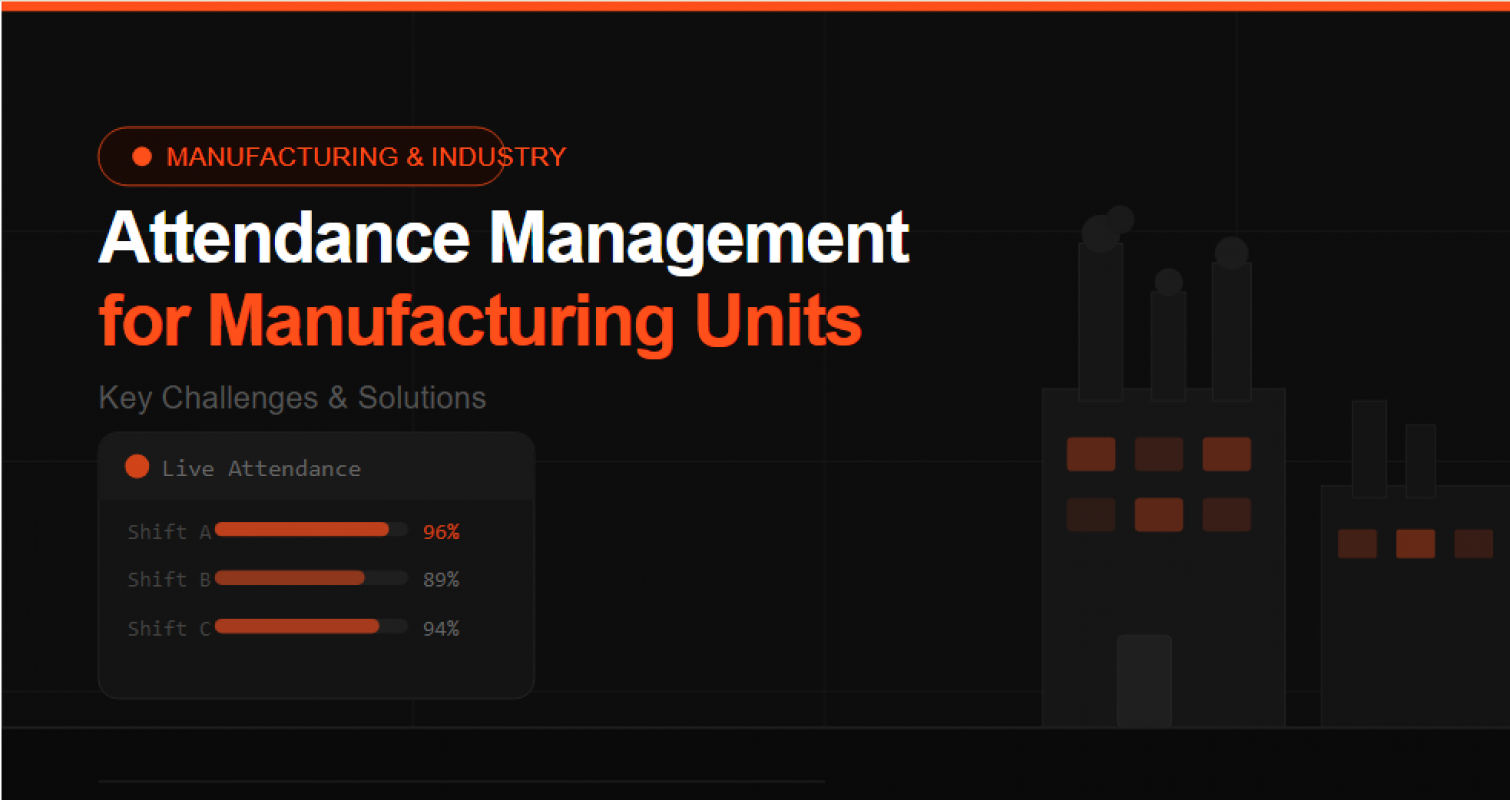
Manufacturing plants are high-pressure environments multi-shift operations, contract labour, safety compliance, and strict production timelines all running simultaneously. Yet many factories still rely on outdated attendance methods like paper registers, punch cards, or disconnected biometric devices.
The result? Payroll errors, compliance risks, workforce disputes, and hours of manual reconciliation every single day.
Modern manufacturing needs modern attendance management.
The Reality on the Factory Floor
Attendance tracking in manufacturing is far more complex than simple clock-in and clock-out systems.
Factories deal with:
- 24/7 rotating shifts
- Contractor and temporary workforce management
- Overtime tracking
- Labour law compliance
- Multi-plant operations
- Payroll dependency on attendance accuracy
When attendance systems fail, operations suffer immediately.
Key Challenges Manufacturing Units Face
1. Multi-Shift Complexity
Managing A, B, and C shifts across continuous operations creates constant attendance movement. Overlapping schedules, overtime calculations, and shift handovers often lead to reporting errors.
In many plants, HR teams spend hours every morning reconciling attendance data manually instead of focusing on workforce management.
Common issues:
- Shift overlaps
- Incorrect overtime calculations
- Missed attendance during handovers
- Delayed absentee reports
2. Contract & Temporary Workforce Tracking
Many manufacturing units operate with 30–60% contract labour. Managing contractor attendance separately from permanent employees creates operational and compliance challenges.
Without a unified system:
- Attendance records become inconsistent
- Wage disputes increase
- Compliance gaps appear during audits
- Contractor productivity becomes difficult to monitor
3. Buddy Punching & Time Theft
Proxy attendance is one of the biggest hidden payroll losses in manufacturing.
When workers clock in for others using cards or manual registers, factories end up paying for hours never worked.
In large plants, this can silently drain lakhs from payroll every month.
Traditional systems fail because:
- Paper registers are easy to manipulate
- Swipe cards can be shared
- Manual verification is impossible at scale
4. Labour Law & Compliance Challenges
Manufacturing units must maintain accurate attendance records for:
- Factories Act compliance
- PF and ESIC reporting
- Overtime regulations
- State labour law audits
Manual systems almost always create documentation gaps.
Many factories discover compliance issues only during inspections — when penalties are already unavoidable.
5. Multi-Location Operations
Enterprises operating multiple plants often struggle with fragmented attendance systems.
Different locations maintain:
- Separate Excel sheets
- Different reporting formats
- Delayed updates
- Inconsistent policies
Without centralized visibility, corporate HR teams are always working with outdated information.
6. Payroll Errors & Workforce Disputes
Manual attendance processing directly impacts payroll accuracy.
Errors in:
- Overtime calculations
- Leave deductions
- Incentive payouts
- Shift allowances
can quickly damage workforce trust.
In manufacturing, a worker who doesn’t trust their payslip becomes disengaged — and disengagement impacts productivity.
Solutions: How Modern Attendance Systems Solve These Problems
Solution 1: Automate Shift Management
A modern attendance platform should automatically manage:
- Rotating shifts
- Split shifts
- Flexible schedules
- Overtime calculations
- Shift handovers
What to look for:
- Configurable shift templates
- Automatic OT calculation
- Live shift dashboards
- Instant absentee alerts
- Supervisor notifications
When managers get real-time workforce visibility, operations become proactive instead of reactive.
Solution 2: Eliminate Proxy Attendance with Biometrics
Modern biometric and facial recognition systems prevent buddy punching completely.
Advanced systems now support:
- Fingerprint authentication
- Facial recognition with liveness detection
- Mobile punch-in for field workers
- Geo-fenced attendance tracking
Key benefits:
- Accurate attendance records
- Reduced payroll leakage
- Real-time fraud detection
- Higher workforce accountability
Solution 3: Build Compliance into the System
Compliance should be automated not manually prepared during audits.
A modern attendance system should automatically generate:
- Muster rolls
- Wage registers
- Overtime reports
- Statutory compliance reports
Essential features:
- Indian labour law templates
- PF & ESIC configuration
- Overtime cap alerts
- Audit-ready records
- Timestamp-based audit trails
This reduces compliance stress significantly for HR and plant operations teams.
Solution 4: Centralize Multi-Plant Visibility
Manufacturing leaders need a single dashboard to monitor attendance across all locations.
A centralized system enables:
- Real-time workforce visibility
- Plant-wise analytics
- Department-level tracking
- Cross-location comparisons
What to look for:
- Unified dashboard
- Role-based access
- Plant-specific policy settings
- Real-time attendance summaries
Corporate HR gains better control while individual plants maintain operational flexibility.
Solution 5: Integrate Attendance Directly with Payroll
Attendance data should flow automatically into payroll systems without manual intervention.
Direct integration eliminates:
- Excel dependency
- Manual data entry
- Payroll delays
- Reconciliation errors
Important capabilities:
- API-based payroll integration
- Automated leave deductions
- OT and incentive calculations
- Employee self-service access
- Same-day payroll processing
Accurate payroll builds workforce trust and trust improves retention.
Traditional System vs. Modern Attendance Management: A Comparison
| Challenge | Legacy / Manual System | Modern Solution |
|---|---|---|
| Multi-shift tracking | Separate registers, error-prone | Automated, real-time across all shifts |
| Buddy punching | Impossible to detect consistently | Biometric & face ID eliminates it |
| Contract workforce | Maintained separately, often inaccurate | Unified tracking with contractor-specific rules |
| Compliance reporting | Manual compilation, audit-time panic | Auto-generated, always audit-ready |
| Payroll integration | Manual data entry, 3–5 day delay | Direct API sync, same-day processing |
| Multi-location visibility | Email reports, next-day data | Live dashboard, any device |
| Employee self-service | None — HR handles everything | Mobile app: leaves, punch-in, payslips |
Manufacturing companies that modernize attendance management achieve more than operational efficiency.
They build:
- Better compliance
- More accurate payroll
- Higher workforce transparency
- Reduced payroll leakage
- Stronger employee trust
When workers know their attendance and wages are tracked fairly, productivity improves naturally.
The factory floor is already complex enough. Your attendance system should simplify operations not add more manual work.
If your manufacturing unit still relies on registers, punch cards, or disconnected biometric systems, the cost of staying with outdated processes is likely far higher than the cost of upgrading.
Ready to Modernize Attendance Management?
Attendify helps manufacturing units automate attendance, simplify compliance, manage shifts efficiently, and integrate directly with payroll systems.
Book a free demo to explore how Attendify can support your plant’s specific shift structure, workforce requirements, and operational workflows.




Comments
Loading comments...