




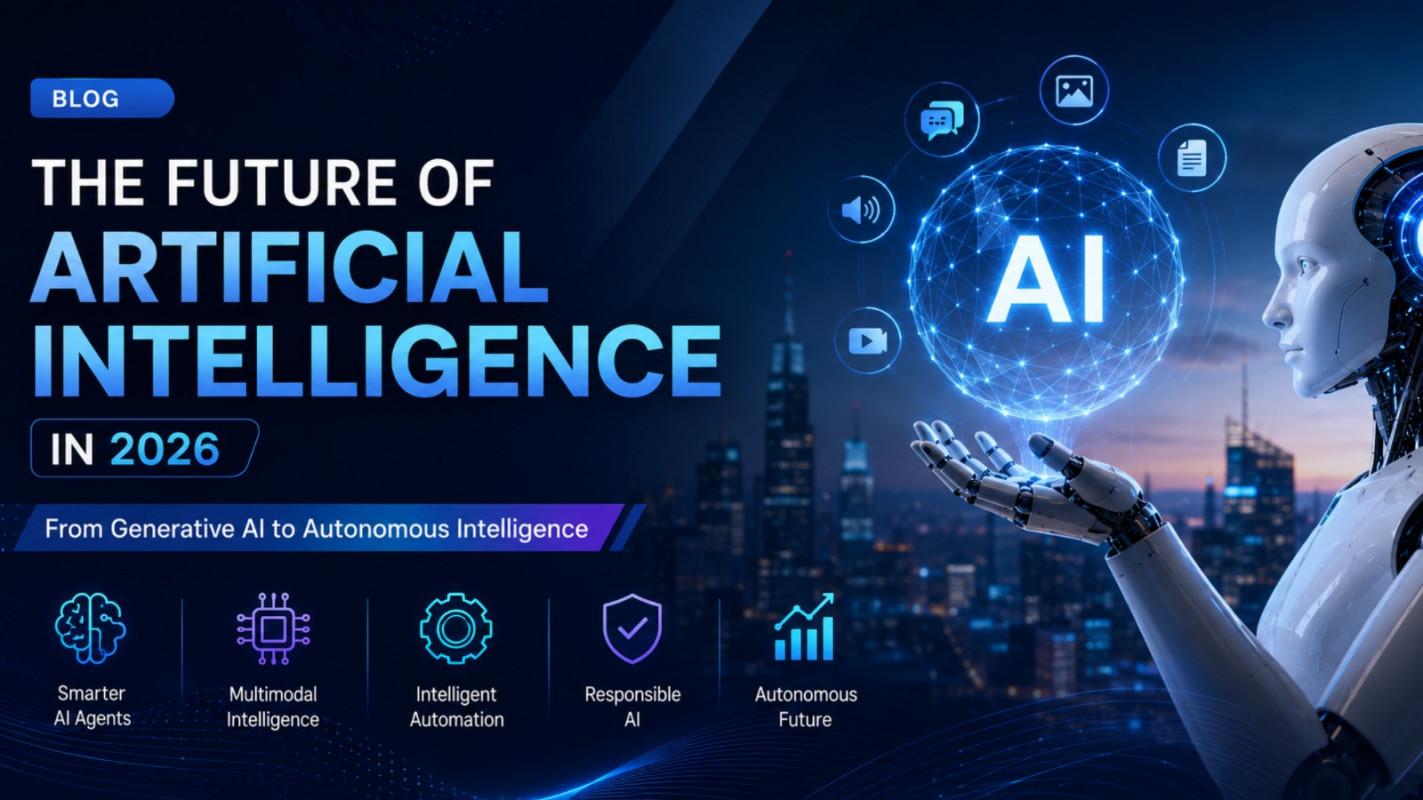
The Future of AI in 2026: From Generative AI to Autonomous Intelligence
Artificial Intelligence (AI) is no longer just a futuristic concept—it has become a driving force behind innovation, productivity, and digital transformation across industries. Over the past few years, Generative AI has changed the way people create content, write code, design visuals, and interact with technology. As we move through 2026, AI is entering a new phase known as Autonomous Intelligence, where systems can not only generate information but also make decisions, plan actions, and execute tasks independently.
1. The Rise of Agentic AI
One of the most significant AI trends in 2026 is the emergence of Agentic AI. Unlike traditional AI assistants that respond to individual prompts, AI agents can understand objectives, create action plans, and complete multi-step tasks with minimal human involvement.
Key Benefits:
- Automates repetitive business processes
- Improves operational efficiency
- Reduces manual workload
- Enhances productivity across teams
Example:
An AI agent can schedule meetings, send emails, generate reports, and track project progress without requiring continuous user input.
2. Multimodal AI is Becoming the New Standard
Modern AI systems are no longer limited to processing text. Multimodal AI can understand and analyze multiple data types, including:
- Text
- Images
- Audio
- Video
- Documents
This capability enables AI to gain a more comprehensive understanding of real-world situations and deliver more accurate insights.
Applications:
- Smart classrooms and educational analytics
- Medical diagnosis and healthcare support
- Video surveillance and security systems
- Customer support and virtual assistants
As businesses continue to generate vast amounts of data, multimodal AI will play a critical role in turning information into actionable intelligence.
3. Smaller and Smarter AI Models
While large language models have gained widespread attention, organizations are increasingly adopting smaller, specialized AI models designed for specific tasks. These models offer several advantages:
Advantages:
- Faster response times
- Lower infrastructure costs
- Improved data privacy
- Reduced energy consumption
- Easier deployment on local devices
This shift allows companies to implement AI solutions more efficiently while maintaining performance and scalability.
4. AI-Powered Automation Across Industries
AI is transforming industries by automating complex workflows and improving decision-making.
Education
- Automated attendance tracking
- Student engagement analysis
- Personalized learning experiences
Healthcare
- Medical image analysis
- Patient monitoring
- Clinical decision support
Manufacturing
- Predictive maintenance
- Quality inspection
- Process optimization
Business Operations
- Intelligent document processing
- Automated customer support
- Data-driven decision-making
Organizations that successfully integrate AI into their workflows are experiencing increased efficiency, reduced costs, and improved customer satisfaction.
5. Responsible AI and Governance
As AI adoption grows, concerns around security, privacy, transparency, and ethics are becoming increasingly important. Businesses and governments are working to establish frameworks that ensure AI is used responsibly.
Key Focus Areas:
- Data privacy protection
- Bias reduction
- Explainable AI
- Regulatory compliance
- Cybersecurity
Building trust in AI systems will be essential for long-term adoption and success.
6. The Future of Autonomous Intelligence
The next stage of AI evolution goes beyond generating content. Autonomous Intelligence focuses on creating systems that can:
- Understand complex objectives
- Make informed decisions
- Learn from outcomes
- Adapt to changing environments
- Collaborate effectively with humans
These capabilities will enable AI to become a valuable partner in solving business challenges, accelerating innovation, and supporting strategic growth.
Conclusion
The future of Artificial Intelligence in 2026 is defined by a shift from Generative AI to Autonomous Intelligence. Technologies such as Agentic AI, Multimodal AI, and intelligent automation are reshaping industries and creating new opportunities for innovation. At the same time, organizations must prioritize responsible AI practices to ensure security, transparency, and ethical use.
As AI continues to evolve, it will move beyond being a tool that simply responds to requests and become an active collaborator capable of driving meaningful outcomes. Businesses that embrace these advancements today will be better prepared to lead in an increasingly AI-powered world.
AI is no longer just about generating answers—it is about taking intelligent actions and creating real-world impact.




Comments
Loading comments...